|
SuperNOVAS C++ API v1.6
High-precision C/C++ astrometry library
|
|
SuperNOVAS C++ API v1.6
High-precision C/C++ astrometry library
|
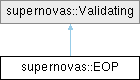
IERS Earth Orientation Parameters (EOP). More...
#include <supernovas.h>
Public Member Functions | |
| EOP (int leap_seconds, const Interval &dut1, const Angle &xp, const Angle &yp) | |
| Instantiates new Earth Orientation Parameters (EOP) with the specified mean (interpolated) values. | |
| EOP (int leap_seconds, double dut1_sec=0.0, double xp_rad=0.0, double yp_rad=0.0) | |
| Instantiates new Earth Orientation Parameters (EOP) with the specified mean (interpolated) values. | |
| Interval | dUT1 () const |
| Returns the UT1 - UTC time difference as a time interval. | |
| EOP | itrf_transformed (int from_year, int to_year) const |
| Transforms these Earth Orientation Parameters (EOP) to a different ITRF realization. | |
| int | leap_seconds () const |
| Returns the leap seconds (TAI - UTC time difference) in seconds. | |
| bool | operator!= (const EOP &eop) const |
| Checks if these Earth Orientation Parameters differ from another by more than 1 μs / 1 μas. | |
| bool | operator== (const EOP &eop) const |
| Checks if these Earth Orientation Parameters are the same as another, within 1 μs / 1 μas accuracy. | |
| std::string | to_string () const |
| Returns a string representation of these Earth Orientation Paramaters (EOP). | |
| const Angle & | xp () const |
| Returns the IERS x pole offset (xp) as an angle. | |
| const Angle & | yp () const |
| Returns the IERS y pole offset (yp) as an angle. | |
| Public Member Functions inherited from supernovas::Validating | |
| bool | is_valid () const |
| Returns the previously set 'valid' state of the implementing instance. | |
| operator bool () const | |
| Objects that implement Validating can be used in conditionals directly, without explicitly calling is_valid(). | |
Static Public Member Functions | |
| static EOP | fetch_current (const Interval &offset, long timeout_millis=0L) |
| Obtains cubic spline interpolated Earth Orientation Parameters (EOP) from the International Earth Rotation and Reference Systems Service (IERS) for the current time instant, or an offset time from the current time. | |
| static EOP | fetch_current (double offset=0.0, long timeout_millis=0L) |
| Obtains cubic spline interpolated Earth Orientation Parameters (EOP) from the International Earth Rotation and Reference Systems Service (IERS) for the current time instant, or an offset time from the current time. | |
| static EOP | fetch_for (const CalendarDate &date, long timeout_millis=0L) |
| Obtains cubic spline interpolated Earth Orientation Parameters (EOP) from the International Earth Rotation and Reference Systems Service (IERS). | |
| static EOP | fetch_for (const time_t time, long timeout_millis=0L) |
| Obtains cubic spline interpolated Earth Orientation Parameters (EOP) from the International Earth Rotation and Reference Systems Service (IERS). | |
| static EOP | fetch_for_jd (double jd, long timeout_millis=0L) |
| Obtains cubic spline interpolated Earth Orientation Parameters (EOP) from the International Earth Rotation and Reference Systems Service (IERS). | |
| static EOP | fetch_for_mjd (double mjd, long timeout_millis=0L) |
| Obtains cubic spline interpolated Earth Orientation Parameters (EOP) from the International Earth Rotation and Reference Systems Service (IERS). | |
| static const EOP & | undefined () |
| Returns a reference to a statically defined standard invalid EOP. | |
Additional Inherited Members | |
| Protected Member Functions inherited from supernovas::Validating | |
| Validating () | |
| dummy constructor; | |
| Protected Attributes inherited from supernovas::Validating | |
| bool | _valid = false |
| the state variable. | |
IERS Earth Orientation Parameters (EOP).
IERS publishes daily values, short-term and medium-term forecasts, and historical data for the measured, unmodelled (by the IAU 2006 precession-nutation model), xp, yp pole offsets, leap-seconds (UTC - TAI difference), and the current UT1 - UTC time difference for various ITRF realizations.
The xp, yp pole offsets define the true rotational pole of Earth vs the dynamical equator of date, while the leap_seconds and UT1 - UTC time difference trace the variations in Earth's rotation.
EOP are necessary both for defining or accessing astronomical times of the UT1 timescale (e.g. for sidereal time or Earth-rotation angle (ERA) calculations), or for converting coordinates between the preudo Earth-fixed Terrestrial Intermediate Reference System (TIRS) on the dynamical equator of date, and the Earth-fixed International Terrestrial Reference System (ITRS) on the true rotational equator.
NOTES:
|
explicit |
Instantiates new Earth Orientation Parameters (EOP) with the specified mean (interpolated) values.
| leap_seconds | [s] Leap seconds (TAI - UTC). |
| dut1_sec | [s] (optional) UT1 - UTC time difference (default: 0.0) |
| xp_rad | [rad] (optional) IERS xp mean (interpolated) pole offset in the ITRS x direction. (default: 0.0) |
| yp_rad | [rad] (optional) IERS yp mean (interpolated) pole offset in the ITRS y direction. (default: 0.0) |
References leap_seconds().
| supernovas::EOP::EOP | ( | int | leap_seconds, |
| const Interval & | dut1, | ||
| const Angle & | xp, | ||
| const Angle & | yp ) |
Instantiates new Earth Orientation Parameters (EOP) with the specified mean (interpolated) values.
| leap_seconds | [s] Leap seconds (TAI - UTC). |
| dut1 | (optional) UT1 - UTC time difference (default: 0.0) |
| xp | (optional) IERS xp mean (interpolated) pole offset in the ITRS X direction (default: 0.0) |
| yp | (optional) IERS yp mean (interpolated) pole offset in the ITRS y direction (default: 0.0) |
References leap_seconds(), xp(), and yp().
| Interval supernovas::EOP::dUT1 | ( | ) | const |
Returns the UT1 - UTC time difference as a time interval.
References supernovas::Validating::is_valid().
Referenced by supernovas::Time::from_mjd(), supernovas::Time::now(), and supernovas::CalendarDate::to_time().
|
static |
Obtains cubic spline interpolated Earth Orientation Parameters (EOP) from the International Earth Rotation and Reference Systems Service (IERS) for the current time instant, or an offset time from the current time.
NOTES:
| offset | (optional) time offset from current time (default: 0.0). |
| timeout_millis | [ms] (optional) HTTP connection timeout, or <=0 to leave unchanged. |
References fetch_current(), and supernovas::Interval::seconds().
|
static |
Obtains cubic spline interpolated Earth Orientation Parameters (EOP) from the International Earth Rotation and Reference Systems Service (IERS) for the current time instant, or an offset time from the current time.
NOTES:
| offset | [s] (optional) time offset from current time (default: 0.0). |
| timeout_millis | [ms] (optional) HTTP connection timeout, or <=0 to leave unchanged. |
References fetch_for(), and supernovas::Validating::is_valid().
Referenced by fetch_current().
|
static |
Obtains cubic spline interpolated Earth Orientation Parameters (EOP) from the International Earth Rotation and Reference Systems Service (IERS).
NOTES:
| date | Calendar date for which to try get EOP. |
| timeout_millis | [ms] (optional) HTTP connection timeout, or <=0 to leave unchanged. |
References fetch_for(), and supernovas::CalendarDate::unix_time().
|
static |
Obtains cubic spline interpolated Earth Orientation Parameters (EOP) from the International Earth Rotation and Reference Systems Service (IERS).
NOTES:
| time | UNIX time for which to try get EOP. |
| timeout_millis | [ms] (optional) HTTP connection timeout, or <=0 to leave unchanged. |
References fetch_for_jd(), supernovas::Validating::is_valid(), NOVAS_JD_J2000, and UNIX_SECONDS_0UTC_1JAN2000.
Referenced by fetch_current(), and fetch_for().
|
static |
Obtains cubic spline interpolated Earth Orientation Parameters (EOP) from the International Earth Rotation and Reference Systems Service (IERS).
NOTES:
| jd | [day] Julian Date (preferably UTC-based). |
| timeout_millis | [ms] (optional) HTTP connection timeout, or <=0 to leave unchanged. |
References supernovas::Unit::arcsec, novas_eop::dut1, supernovas::Validating::is_valid(), novas_eop::leap, novas_fetch_eop(), undefined(), novas_eop::xp, and novas_eop::yp.
Referenced by fetch_for(), and fetch_for_mjd().
|
static |
Obtains cubic spline interpolated Earth Orientation Parameters (EOP) from the International Earth Rotation and Reference Systems Service (IERS).
NOTES:
| mjd | [day] Modified Julian Date (preferably UTC-based). |
| timeout_millis | [ms] (optional) HTTP connection timeout, or <=0 to leave unchanged. |
References fetch_for_jd(), supernovas::Validating::is_valid(), and NOVAS_JD_MJD0.
| EOP supernovas::EOP::itrf_transformed | ( | int | from_year, |
| int | to_year ) const |
Transforms these Earth Orientation Parameters (EOP) to a different ITRF realization.
| from_year | [yr] the ITRF realization of these EOP values. |
| to_year | [yr] the ITRF realization in which to return EOP |
References supernovas::Unit::arcsec, supernovas::Validating::is_valid(), and novas_itrf_transform_eop().
| int supernovas::EOP::leap_seconds | ( | ) | const |
Returns the leap seconds (TAI - UTC time difference) in seconds.
Referenced by EOP(), EOP(), supernovas::Time::from_mjd(), supernovas::Time::now(), and supernovas::CalendarDate::to_time().
| bool supernovas::EOP::operator!= | ( | const EOP & | eop | ) | const |
Checks if these Earth Orientation Parameters differ from another by more than 1 μs / 1 μas.
| eop | another set of Earth Orientation Parameters |
| bool supernovas::EOP::operator== | ( | const EOP & | eop | ) | const |
Checks if these Earth Orientation Parameters are the same as another, within 1 μs / 1 μas accuracy.
| eop | another set of Earth Orientation Parameters |
References supernovas::Unit::uas, and supernovas::Unit::us.
| std::string supernovas::EOP::to_string | ( | ) | const |
|
static |
Returns a reference to a statically defined standard invalid EOP.
This invalid EOP may be used inside any object that is invalid itself.
Referenced by fetch_for_jd(), and supernovas::Time::operator-().
| const Angle & supernovas::EOP::xp | ( | ) | const |
Returns the IERS x pole offset (xp) as an angle.
Referenced by EOP(), supernovas::GeodeticObserver::equals(), supernovas::GeodeticObserver::gcrs_position_at(), and supernovas::GeodeticObserver::gcrs_velocity_at().
| const Angle & supernovas::EOP::yp | ( | ) | const |
Returns the IERS y pole offset (yp) as an angle.
Referenced by EOP(), supernovas::GeodeticObserver::equals(), supernovas::GeodeticObserver::gcrs_position_at(), and supernovas::GeodeticObserver::gcrs_velocity_at().
 1.17.0